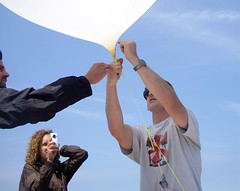
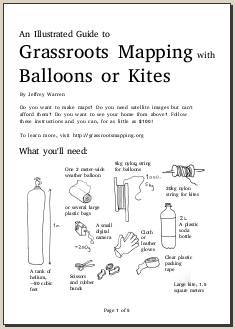
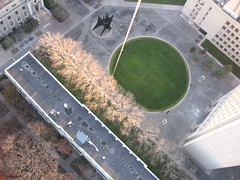
Grassroots Mapping is a series of participatory mapping projects involving communities in cartographic dispute. Seeking to invert the traditional power structure of cartography, the grassroots mappers used helium balloons and kites to loft their own “community satellites” made with inexpensive digital cameras.
At Public Lab, we've grown the Grassroots Mapping community into a broader effort to enable communities to understand and respond to environmental threats with DIY techniques.
We held a Ballon Mapping and Kite Making Workshop on the Campus of San Marcos on Jan. 28, 2012 with a group of about 10 people from: Open Street Map Peru, Saberes Nomadas, and San Marcos Univ. (physics, geography, sociology, and geographic engineering depts.)
I've made an instructional video on efficient image sorting with Preview and Finder, for quickly winnowing down big groups of images to small sets, ready for MapKnitter:
Instead of using a balled up piece of tape, a pebble, or some other thing to hold down my camera's shutter, I've gone to using a knot. This makes it easy to hold in place, and makes setting it easier. I prefer a rubber band, but tape also holds it down. tape may be more useful for bulging, non rectangular cameras.
This is a snapshot of some multispectral imaging that I have been working on with Pat Coyle at the organic agriculture park in Sunol, California. http://www.sagecenter.org/sunol-agpark/
This is a snapshot of some multispectral imaging that I have been working on with Pat Coyle at the organic agriculture park in Sunol, California. http://www.sagecenter.org/sunol-agpark/
Hello. I'm jaekyung lee from South Korea.
These days, I'm trying to get picture at 350 meters high.
Two weeks ago, at last I could get picture and return my camera and camcorder.
저는 한국의 이재경입니다. 퍼블릭라보라토리의 풍선맵핑을 참고하여 한국에서 도시맵핑 프로젝트를 진행했습니다. 약간은 방법에 차이는 있을 수 있지만, jeff의 방법 모델을 많이 참고했습니다. 한국에서 구하기 쉬운 재료를 사용했고 모든 내용은 퍼블릭 라보라토리와 구글 사이트도구에 한국어로 공유하였습니다.
Are you embroiled in an cartographic dispute? Do you disagree with the official version of your geography? Contact us through the public mailing list.
Grassroots Mapping is part of the Public Laboratory for Open Technology and Science, founded by a group of activists, educators, technologists, and community organizers interested in new ways to promote action, intervention, and awareness through a participatory research model.
Purchase the Grassroots Mapping Forum, our new community research journal/archive/zine/map, where we hope to share ideas, techniques, and stories from the Grassroots Mapping community. It is printed on a single 22.75x35" newsprint sheet, folded down to just over letter size, and includes a full color reproduction of a grassroots map along with essays, illustrated guides, and interviews on the reverse.
We're helping citizens to use balloons, kites, and other simple and inexpensive tools to produce their own aerial imagery of the spill… documentation that will be essential for environmental and legal use in coming yeas.We believe in complete open access to spill imagery and are releasing all imagery into the public domain.
Techniques and tools for people who want to make maps, on the Public Laboratory wiki. Includes readings and case studies on grassroots mapping projects.